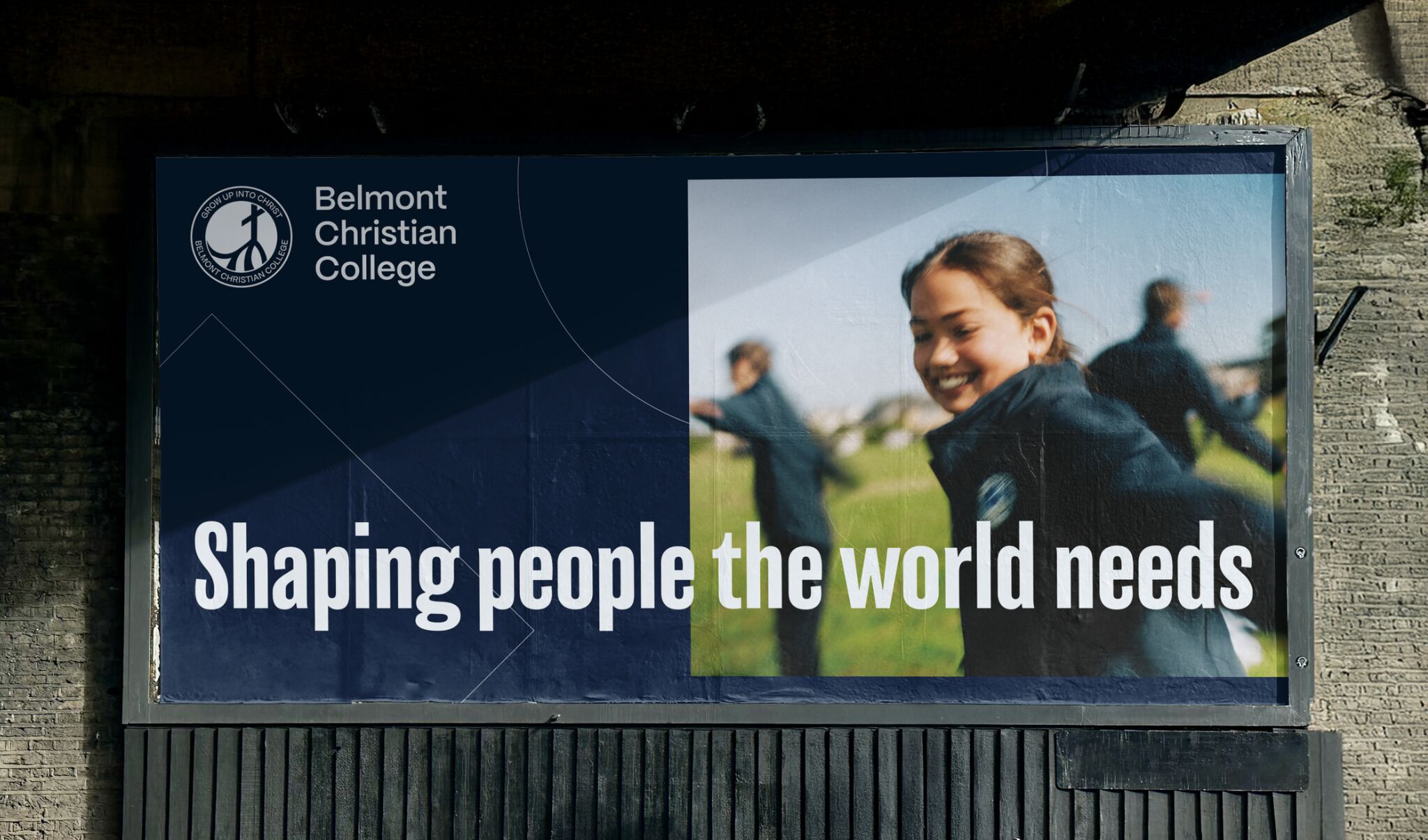
Belmont Christian College’s purpose statement reads: for Christ, we are shaping engaged, purposeful people whose lives impact families, communities, and culture.
The distilled version is “shaping people the world needs”. A lot of deep thinking sits under those words, and the thing we’re proudest of is that the statement was built to be generative rather than restrictive.
We wrote it with great care.
We didn’t want it to be only altruistic – where the single picture of a successful Belmont student is someone changing the world on a global scale. We wanted something fuller. Success is the person changing the world, yes, but it’s just as much the person serving their family faithfully, or, smaller again, being a good and well human. The emphasis is on engaged and purposeful: not in some grand sense, but that in whatever they do, they move through life with a sense of purpose.
You can see the expanding picture in the line itself, lives that impact families, communities, and culture, a ripple moving outward.
Two other things were deliberate. Shaping isn’t student-specific. We wrote it to include everyone the school comes into contact with: leaders, staff, teachers, students, families, the wider Belmont community, all of them shaped to be a little more engaged and purposeful. And For Christ is the anchor, the organising function the shaping happens under – speaking directly to the school’s underlying beliefs.
The statement scales. It expands up into a fuller exploration of what it looks like in reality. It holds at shaping people the world needs. And it shrinks down to shaping people, or even just shaping. It works at every size, which is what I mean by generative: it gives you more rather than fencing you in.
Two messaging moves grew straight out of it. The first is people the world needs, which carries an emotional charge, because the world does need good humans: in families, in relationships, leading on the things that matter. That connects to a deep parental desire. You want your child to be safe, and you also want them to be the kind of person who adds to the world.
The second is “this is where it all begins”. Again, helping to ground the big statement in ‘it starts here, at this school’. You’ve just travelled this whole macro timeline, a person being shaped over years into someone the world needs, and then it all shrinks to a single micro moment: this is where it all begins. This is the place you want that to start for your child.
A year on, it’s become a world. Walk into the front office and there’s a book we designed, A Foundation of Faith: A Future of Impact, an immersive run through the purpose, the values, and the strategic plan, from altruistic to pragmatic, all of it backed by story, language, and visuals that align. Go to the website and you see the same purpose lockup, the same imagery, the brand film. Shaping people, everywhere. That’s the payoff of writing a purpose to be generative: a year later the school still has language it can keep building with.